Before and After Serial Casting: What Changes for Your Child
QUICK ANSWER Serial casting is best known for toe walking, but our PTs also use […]
Therapy
If you believe your child’s foot condition—such as toe walking, clubfoot, or arthrogryposis—can only be treated with surgery, there are non-surgical options worth exploring. Pediatric serial casting is a safe, non-invasive approach that gradually improves alignment and mobility.
At Westside, our serial casting program gently stretches tight muscles over time, helping guide the body into better alignment. The goal is to support more comfortable movement and make everyday activities easier for your child.
Serial casting is a non-invasive method used to improve joint range of motion for a variety of diagnoses, including toe walking, cerebral palsy, arthrogryposis, spina bifida, club foot, traumatic and acquired brain injuries, and muscular dystrophy.
This is an alternative to surgery for many children who have excessive stiffness in their legs and feet. Each week, the specialist will fit your child for a cast that applies slight pressure to stretch the joint while they continue to stay active and live their regular lives.
QUICK ANSWER Serial casting is best known for toe walking, but our PTs also use […]
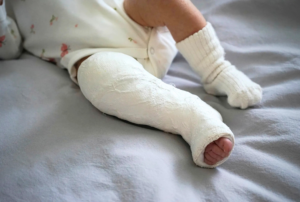
QUICK ANSWER Serial casting is the first phase of the Ponseti method, the global standard […]
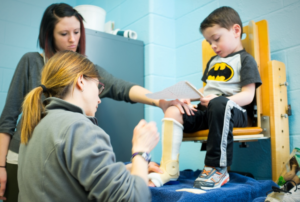
QUICK ANSWER Most toe walking in young children is idiopathic, meaning it happens without any […]
Toe walking is when a child walks around on the balls of their feet with no contact between their heel and the ground.
Toe walking that continues for a long period during a child’s critical developmental stages can lead to severe stiffness of the muscles in the foot and ankle. At this point, serial casting is needed to correct the condition. Surgery is often the only alternative to serial casting, and the costs, pain, and rehabilitation timeline can be significantly higher than non-invasive serial casting. Also, surgery only addresses the primary problem, while serial casting focuses on the whole foot.
Serial casting is a good way to avoid the risks and costs of surgical intervention and, at the same time, improve your child’s long-term outcomes.
If your child is not walking properly or experiencing other foot problems, delaying treatment can affect their overall quality of life and pose future challenges. With pediatric serial casting, families can ensure their child walks without discomfort and comfortably performs other daily activities. These non-invasive methods offer various benefits, including:
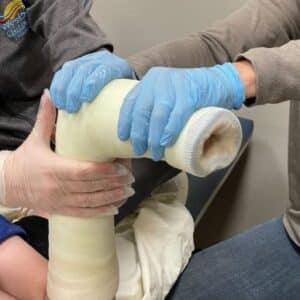
It is advisable to start serial casting early. It helps children adjust better, preventing difficulties later in life. Read more about the reasons why an early start is highly recommended.
Learn MoreAt Westside, we do not believe in a template approach. We first understand how much work a child’s ankles and muscles require and then build the program from there. Our experts use evidence-backed treatment plans to achieve goals. Here is what a pediatric serial casting process at Westside looks like:

Many treatment plans exist for foot conditions in children. However, to determine whether serial casting is the best fit for your child, our specialists conduct a thorough evaluation of range of motion, muscle tightness, foot alignment, and more. These evaluations enable them to ascertain the duration of the treatment plan, what to expect, and what goal they will be working towards.

Serial casting, as the name suggests, involves experts updating the casts weekly and making the necessary adjustments to gradually treat the condition. The child visits the center every week to have their previous cast replaced with a new one. Every time, a new cast is fitted to increase muscle stretch and boost mobility. The replacement is pretty straightforward and quick. Children take only a day or two to adjust to the new casts.

Our specialists create treatment plans tailored to your child’s specific needs. Progress is closely monitored at each visit, allowing the team to adjust the approach as needed. They assess factors like range of motion, muscle strength, and stiffness to guide each step of care. Once casting is complete, children typically transition into Ankle-Foot Orthoses (AFOs) and night splints to help maintain the progress achieved and support long-term results.
Pediatric serial casting is most effective when each application is precise, and the process is carried out consistently. At Westside, our specialists focus on getting those details right while keeping your child comfortable and supported throughout the process. We work closely with families to stay aligned on goals and progress every step of the way. Here are a few more reasons families trust us:
If you notice your child struggling to walk properly, schedule a consultation with a specialist to discuss your concerns. Whether it is toe-walking, spina bifida, or any other concern, our specialists can clarify your doubts and explain the next steps. They can guide you about the best treatment plans, what to expect, and how to get started.
Getting started with Westside is easy; simply contact us, and our staff will help you understand the process. From the get-go, you can expect steady and compassionate help. Early intervention can make a real difference in your child’s quality of life.

Casting
Casting
Abbie Zaremba, PT, DPT, holds a B.S. in Kinesiology and a Doctorate of Physical Therapy (DPT). She brings clinical experience from her time at Athletico and is dedicated to providing thoughtful, individualized care for children and families.
In her current role as a Serial Casting Coordinator, Abbie focuses on supporting patients through the serial casting process with a steady, encouraging approach and close attention to progress and comfort.
Outside of the clinic, Abbie enjoys hiking, traveling, exercising, painting, and spending time with family and friends.
Yes! This is ideal. It depends on the insurance you have, but the advantages of physical therapy with serial casting are huge. It is strongly recommended to maximize casting outcomes.
Following casting, AFOs should be worn during daytime hours for a timeframe of two to three years. Night splints must be worn at night. Therapists guide families about this standard protocol and whether changes will be required later.
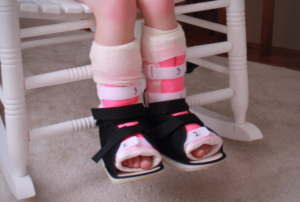
The casts are off, time to wear AFOs and night splints
An AFO is worn to maintain proper alignment and control motion. Children must wear these during the day to achieve maximum results.
The AFO will hold the feet at a 90-degree ankle angle, and the night splints will hold them approximately 20-plus degrees beyond that. Night splints are worn while sleeping and help to keep the muscles in an elongated stretch. Our therapists say that AFOs should be worn 23 out of 24 hours.
The AFOs and night splints can come off after about two to three years, but that depends on the following:
Age of the child — the older the child, the quicker they can graduate from AFOs.
Children who are out of their AFOs and night splints the fastest often have high motivation, as does their family. A child who loses range will not be able to wear AFOs anymore, and progress can be lost.
In order to get out of braces, your child has to be able to keep their center of mass (pelvis) back and lead with their feet. A main cause of toe walking is a child’s center of mass is too far forward, and in order for them to keep up with their body, a child has to walk on their toes.
The toughest part of the process is breaking the habit of toe walking. It can be easy to do the “doctor walk” (heel-toe-heel-toe), but the most important walk is the casual walk while they walk back to the car or walk and talk with friends. A child who is ready to be out can walk heel-toe without thinking.
After getting used to the additional weight and awkwardness of the cast, your child should be able to do everything that they were doing without the cast. In fact, we encourage children to be as active as possible. Keep the cast from getting wet, and wear a sock over the front to keep the cast clean.
The cost depends on your insurance plan. Please give us a call at (815) 469-1500 and ask for our billing team. We can confirm your benefits and give you a good-faith estimate of your weekly costs for the casting process.
It depends on how much range has been lost in the ankle flexion. The more contracted the ankle is, the longer it takes. We can achieve 2-5 degrees of regained ankle bend every week, depending on how stiff the ankle is and how old the child is (older children take longer). Based on this, treatment can take as little as 3 weeks and as long as 10 months.
It is important to know that an ideal situation would be for a child to receive physical therapy. Each family’s insurance varies, but if insurance allows, our therapists can help develop a therapy plan.
Our therapists want children to stay active while wearing the cast. Go on walks, stretch, perform balance exercises, and play games. Continue to be a kid! This will help improve outcomes.
Children sometimes can do more while wearing casts. It can help a child stand properly and even walk comfortably.
Have your child do exercises
Put their back/butt against the wall and do heel taps. (Helps activate the quad and work the hip flexor, as well as learning to keep the weight back)
Leg rotations
A few times a day, rotate the legs clockwise, counterclockwise, and up and down (helps keep a range of motion)
Stay active with them (go on walks)
If AFOs and night splints are removed too early, a child may lose the range they gained while wearing the casts, as well as the progress made while wearing the AFOs and night splints. A child may also begin walking on their toes again.
This is the equivalent of someone who needs to wear a retainer after getting their braces off.
If your child is experiencing itchiness, we recommend placing a fan on them or, in extreme cases, giving them an antihistamine.
If any of the following occur, please reach out to our clinic immediately:
If you are interested, submit an inquiry below. Our Patient Coordinator will call to help you determine a plan forward. If you are still unsure, you can call us anytime at (815) 469-1500 for more information.