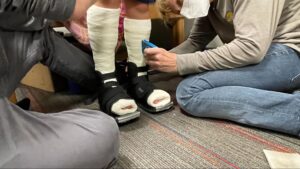
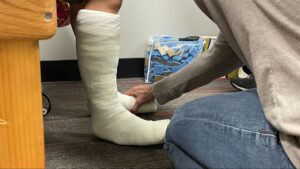
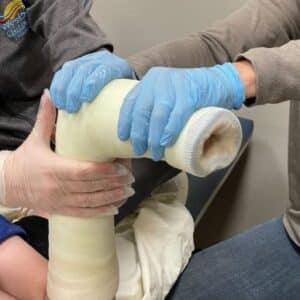
Following casting, AFOs should be worn during daytime hours for a timeframe of two to three years. Night splints must be worn at night. Therapists guide families about this standard protocol and whether changes will be required later.
The casts are off, time to wear AFOs and night splints
An AFO is worn to maintain proper alignment and control motion. Children must wear these during the day to achieve maximum results.
The AFO will hold the feet at a 90-degree ankle angle, and the night splints will hold them approximately 20-plus degrees beyond that. Night splints are worn while sleeping and help to keep the muscles in an elongated stretch. Our therapists say that AFOs should be worn 23 out of 24 hours.
The AFOs and night splints can come off after about two to three years, but that depends on the following:
- Strength is maintained in the once-weak muscles
- Range is maintained
- The habit of toe walking is broken (this can be the toughest)
Age of the child — the older the child, the quicker they can graduate from AFOs.
Children who are out of their AFOs and night splints the fastest often have high motivation, as does their family. A child who loses range will not be able to wear AFOs anymore, and progress can be lost.
In order to get out of braces, your child has to be able to keep their center of mass (pelvis) back and lead with their feet. A main cause of toe walking is a child’s center of mass is too far forward, and in order for them to keep up with their body, a child has to walk on their toes.
The toughest part of the process is breaking the habit of toe walking. It can be easy to do the “doctor walk” (heel-toe-heel-toe), but the most important walk is the casual walk while they walk back to the car or walk and talk with friends. A child who is ready to be out can walk heel-toe without thinking.