Therapy
Serial Casting
Non-surgical, cost-efficient intervention for toe walking and other foot deformities
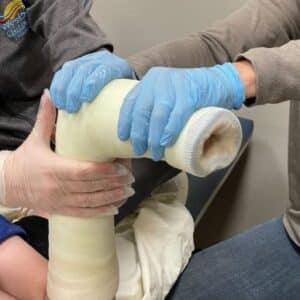
Serial casting is a non-invasive method used to improve joint range of motion for a variety of diagnoses including toe walking, cerebral palsy, arthrogryposis, spina bifida, club foot, traumatic and acquired brain injuries, and muscular dystrophy.
This is an alternative to surgery for many children who have excessive stiffness in their legs and feet. Each week the specialist will fit your child for a cast that applies slight pressure to stretch the joint while they continue to stay active and live their regular lives.
What is Serial Casting used for?
Toe walking is when a child walks around on the balls of their feet with no contact between their heel and the ground.
Toe walking that occurs over a long period of a child’s development can lead to severe stiffness of the muscles in the foot and the ankle. At this point, serial casting is needed to correct the condition. Surgery is often the only alternative to serial casting, and the costs, pain, and rehab timeline can be significantly higher than the process of using non-invasive serial casting. Also, surgery only addresses the primary problem while serial casting focuses on the whole foot. Serial casting is a way to avoid the risks and costs of surgical intervention and at the same time maximize medical outcomes for your child.
5 Reasons to Start Serial Casting early?
Serial casting should be started earlier for children to prevent difficulties adjusting later on in life. Read more about the reasons why an early start is suggested.
Learn MoreFind a Serial Casting location near you
FAQs
-
Do we do physical therapy with serial casting?
Yes! This is ideal. It depends on each person’s insurance, but the advantages of this are huge. It is strongly recommended to maximize casting outcomes.
-
When do AFOs get worn?
Following casting, AFOs should be worn during daytime hours for a timeframe of two to three years. Night splints are worn during nighttime. Therapists will guide families if this standard protocol should change.
The casts are off, time to wear AFOs and night splintsAn AFO is worn to maintain proper alignment and control motion. Children must wear these during the day to achieve maximum results.
The AFO will hold the feet at a 90-degree ankle angle and the night splints will hold them approximately 20-plus degrees beyond that. Night splints are worn to sleep in, and help to keep the muscles in an elongated stretch. Our therapists say that AFOs should be worn 23 out of 24 hours.
The AFOs and night splints can come off after about two to three years, but that is dependent on a few things:
Strength maintained in the muscles that were once weak
Range is maintained
Habit of toe walking is broken (this can be the toughest)
Age of the child- the older the child, the quicker they are able to graduate from AFOs
Children that are out of their AFOs and night splints the fastest often have high motivation, as does their family. A child that loses range will not be able to wear AFOs anymore and progress has been lost.In order to get out of braces, your child has to be able to keep their center of mass (pelvis) back and lead with their feet. A main cause of toe walking is a child’s center of mass is too far forward and in order for them to keep up with their body, a child has to walk on their toes.
The toughest part of the process is to break the habit of toe walking. It can be easy to do the “doctor walk” (heel-toe-heel-toe), but the most important walk is the casual walk while they walk back to the car or walking and talking with friends. A child that is ready to be out can walk heel-toe without thinking.
-
Can my child still do activities?
After getting used to the additional weight and awkwardness of the cast, your child should be able to everything that he/she was doing without the cast. In fact, we encourage your child to be as active as possible. Keep the cast from getting wet, and wear a sock over the front to keep the casts clean.
-
What does it cost?
The cost depends on your insurance plan. Please give us a call at (815) 469-1500 and ask for our billing team. We can confirm your benefits and give you a good-faith estimate of your weekly costs for the casting process.
-
How long does serial casting take?
It depends on how much range has been lost in the ankle flexion. The more contracted the ankle is the longer it takes. We can achieve 2-5 degrees of regained ankle bend every week depending on how stiff the ankle is and how old the child is (older children take longer). Based on this, treatment can take as little 3 weeks and as long as 10 months.
-
What can my child do while wearing the casts?
It is important to know that an ideal situation would be that a child receives physical therapy. Each family’s insurance varies, but if it allows, our therapists can help develop a therapy plan.
Our therapists want the children to stay active while wearing the casts. Go on walks, stretch, do balance exercises, play games, etc. Continue to be a kid! This will help maximize outcomes.
Children sometimes are able to do more while wearing the casts. It can help a child stand still and even comfortably walk.
Do not get the casts wet.
-
How can the family help?
Have your child do exercises
Put their back/butt against the wall and do heel taps. (Helps activate the quad and work the hip flexor, as well as learning to keep weight back)Leg rotations
A few times a day rotate the legs clockwise, counterclockwise and up and down (helps keep a range of motion)Stay active with them (go on walks)
If AFOs and night splints are removed too early, a child may lose the range they gained while wearing the casts as well as the time in the AFOs and night splints. A child may also begin walking on their toes again.
Think of someone who needs to wear a retainer after getting braces off.
-
Common "What If" Questions
If your child is experiencing itchiness, we recommend placing a fan on them or in extreme cases giving them an anti-histamine.
If any of the following occurs, please reach out to our clinic immediately:
- Child is experiencing pain or not sleeping at night
- Casts get wet
- Casts get broken or cracked
Getting Started
If you are interested, submit an inquiry below. Our Patient Coordinator will call to help you determine a plan forward. If you are still unsure, you can call us anytime at (815) 469-1500 for more information.