Autism Diagnostic Testing for Children
Comprehensive Autism Diagnostic Testing
Virtual or In-Person. Answers in Days, Not Months.
If you think your child may have autism, getting answers shouldn’t mean waiting months. That’s why Westside created our virtual autism evaluation program. By rethinking how evaluations are delivered, we’re able to provide timely, dedicated support for families.
We also offer in-person autism evaluations at our Orland Park (North) center, where families are welcomed by our compassionate team.
Virtual vs. In-Person Autism Evaluations at Westside
Autism diagnostic testing is a comprehensive evaluation used to determine whether a child shows characteristics associated with autism spectrum disorder (ASD). Because no single test can diagnose autism, the evaluation considers multiple areas of your child’s development and behavior. Both virtual and in-person autism evaluations include caregiver interviews, developmental history, professional observation, and standardized assessment tools.
Both are trusted, recognized options for diagnosing autism. The biggest differences are location, access, and timing.
Virtual Evaluation
- Secure telehealth from home; no travel required
- Testing typically completed within one week, with results shortly after
- Typically offers sooner appointment availability
In-Person Evaluation
- Requires travel to Westside’s Orland Park (North) clinic
- Testing appointments may be further out, with results taking longer to receive
- Availability may be more limited, with openings scheduled further out
Either Way, You’ll Receive:
- Comprehensive evaluation conducted by a licensed psychologist
- Formal diagnosis and written report
- Personalized recommendations based on your child’s needs
- Support from a family navigator to understand next steps
- A clear path to recommended services and resources
Not sure which is right for your child?
If you’re still deciding which evaluation option is right for your family, we’re here to help. You can start with a short screening questionnaire, and our team will follow up to discuss the results and possible next steps.
Or, submit an inquiry below to connect with a Family Navigator who can answer your questions, talk through your options, and verify your insurance benefits. You can also call us at (815) 469-1500.
Compare both options in more detail:
→ Read: Virtual vs. In-Person Autism Testing: Which Is Right for Your Family?
100+ Insurance Plans Accepted
All diagnostic evaluations are billed through insurance. Before you get started, our team can verify your benefits at no cost and help you understand your out-of-pocket costs.
For more information about costs:
→ Read: How Much Does Autism Testing Cost? Insurance and Payment Options Explained






Signs Your Child May Need an Autism Evaluation
Many families first notice small differences in how their child communicates, plays, or responds to the world around them.
You may be noticing things like:
- Limited or inconsistent eye contact
- Difficulty responding to name or social cues
- Delayed speech, gestures, or communication
- Difficulty with transitions or changes in routine
- Repetitive movements or repeated behaviors (e.g., hand flapping, lining up toys)
- Strong focus on specific interests or objects
- Preference for playing alone or parallel play
If you’re noticing some of these behaviors, you can learn more about early signs of autism and what to do next, or start with a short screening.
Take the QuestionnaireHow an Autism Diagnosis Can Support Your Child
An autism diagnosis can bring up a lot of emotions and questions about what it means for your child. But a diagnosis doesn’t change who your child is or define what they’re capable of. It can simply give you more information to understand their experiences, advocate for their needs, and support them as they grow.
- Better understand your child: Autism affects every child differently. A diagnosis can offer insight into how your child communicates, learns, interacts with others, and responds to change.
- Get support at school: Teachers can better understand your child’s needs and make appropriate accommodations in the classroom.
- Find the right therapies: Healthcare professionals can recommend services such as ABA, speech therapy, occupational therapy, or other developmental support based on your child’s needs.
What Does an Autism Diagnostic Evaluation Assess?
An Autism Spectrum Disorder (ASD) evaluation looks at different areas of your child’s development to better understand how they communicate, interact, learn, and manage everyday activities. There isn’t one single test for autism. Instead, the evaluation brings together information about your child across several areas.
Social Communication
An autism diagnostic evaluation assesses how a child communicates with others, both verbally and non-verbally. The diagnosis may include the child’s speech and language skills, eye contact, facial expression, tone of voice, and conversational skills.
Social Interaction
Diagnosticians also assess how a child connects and interacts with others. For example, how they respond to their name and interact with parents, caregivers, or peers.
Repetitive Behaviors and Interests
Evaluations also assess the child’s interests and repetitive behaviors. This may include hand flapping, rocking, repeating words or phrases, or following a rigid routine. Professionals may also look into highly focused behaviors and difficulty coping with changes.
Developmental and Adaptive Skills
Your child’s developmental history and everyday skills are also considered. This may include language, movement, learning, and play, as well as everyday activities like dressing, eating, toileting, and communicating their needs.
What Families Can Expect During an Autism Diagnostic Evaluation
A Virtual Evaluation Process Designed to Get You Answers Sooner
An autism diagnostic evaluation is a structured process designed to understand a child’s development, behavior, communication, and everyday experiences. Rather than relying on a single test, the evaluation brings together information from parents or caregivers, developmental history, direct observation, and standardized assessment tools to better understand the child. Here is what a child can expect during an evaluation:


Parent Interview
In a 1-on-1 interview, our clinician will ask questions to learn more about your child and what you’re noticing.

Child Observation
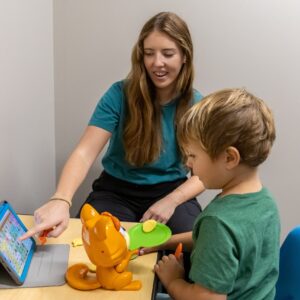
Your child engages in structured, play-based activities while the clinician observes. We guide parents on setup, materials, and interaction.

Results & Diagnostic Report
We determine a diagnosis and send over a written report detailing your child’s developmental profile.

Follow-Up
We review the results with you, answer every question, and explain what the findings mean.
What Happens After an Autism Diagnosis?
We will never hand you a report and leave you to figure out what comes next. When results are ready, we translate them into a clear, practical plan that shows exactly what to do next. This may include:
- Referrals to trusted providers
- Direct access to medical, behavioral, or speech services with Westside
- Therapy or testing recommendations
- Community resources and parent support
- Guidance on financial programs and assistance
For more guidance on what comes after a diagnosis:
→ Read: My Child Was Just Diagnosed With Autism: What Do I Do Now?
Have more questions about autism diagnostic testing?
→ Read: What Happens During an Autism Evaluation? A Step-by-Step Guide for Parents
→ Read: Common Questions About Autism Diagnostic Testing, Answered
Why Families Choose Westside
Every child is different, and their therapy should reflect that. At Westside, we take the time to understand your child, your family, and what matters most in everyday life.
✓ Care Built Around Your Child: Our therapy programs consider your child’s individual strengths, challenges, and needs.
✓ A Supportive, Collaborative Team: We listen to your concerns and work closely with parents and caregivers to better understand your child’s needs.
✓ Skills for Everyday Life: We develop strategies to support communication, social development, learning, and everyday skills.
✓ Support for Your Family: We’re here to make navigating therapy easier with supportive care and evidence-based treatment.
Meet Your Evaluation Team
Experienced Clinicians, Focused on Getting You Clear Answers
From the first conversation through results and next steps, you’ll have a dedicated clinician guiding you the entire process.

Bradford Czochara
Diagnostics
Bradford Czochara
Diagnostics
Bradford Czochara, Psy.D., ABN, LPC, CGP, earned his Psy.D. in Clinical Psychology from Midwestern University. He brings a strong clinical foundation to his work, with experience spanning neuropsychology and rehab psychology across the lifespan.
Bradford’s clinical interests include neurodevelopmental disorders, as well as providing individual psychotherapy and group therapy. He is committed to offering thoughtful, practical support tailored to each person’s needs and strengths.
Outside of his clinical work, Bradford enjoys music, video games, reading, and spending time with his family.

Emily Shearer, Ph.D., Licensed Clinical Psychologist
Diagnostics
Emily Shearer, Ph.D., Licensed Clinical Psychologist
Diagnostics
Emily Shearer is a Licensed Clinical Psychologist with a passion for helping children and families better understand their unique strengths and needs. She earned her Ph.D. in Counseling Psychology from the University of Iowa and has extensive experience providing assessment and psychological services across a variety of clinical settings.
Throughout her career, Dr. Shearer has worked at the University of Iowa Hospitals and Clinics in the Learning and Attention Disorders Clinic, Child and Adolescent Psychology, and the Center for Disabilities and Development. She has also provided services through University of Iowa Counseling Services, LittleStar ABA Therapy, and private practice.
Dr. Shearer specializes in the evaluation and diagnosis of autism, ADHD, and intellectual disabilities. She is dedicated to providing compassionate, evidence-based care that helps families gain clarity, access resources, and confidently move forward with the support their child needs.
Outside of work, Dr. Shearer enjoys spending time with family and friends, reading, playing pickleball, and staying active through regular workouts.

Eun-Yeop Lee, Ph.D., NCSP, BCBA
Diagnostics
Eun-Yeop Lee, Ph.D., NCSP, BCBA
Diagnostics
Eun-Yeop Lee, Ph.D., NCSP, BCBA, is a Massachusetts and Illinois licensed psychologist, PsyPACT-authorized psychologist, pediatric neuropsychologist, Nationally Certified School Psychologist, and Board Certified Behavior Analyst with more than 10 years of experience in residential schools, hospitals, private practices, and therapy centers across several states.
Most recently, Dr. Lee served as a pediatric neuropsychologist at Northwestern Medicine’s Marianjoy Rehabilitation Hospital and the Rush NeuroBehavioral Center. She is dedicated to understanding how neuropsychological profiles and medical conditions impact learning and behavior in children and adolescents.
Dr. Lee earned her doctorate in School Psychology from the University of South Florida, completed her internship in Pediatric Neuropsychology at The Watson Institute, specializing in Autism Spectrum Disorder (ASD) diagnosis, and completed her postdoctoral training at McLean Hospital in Boston.
She has conducted comprehensive neuropsychological and educational evaluations for children with ADHD, Autism Spectrum Disorder, learning disabilities, and other developmental concerns, providing families with individualized educational and behavioral recommendations. Since graduate school, Dr. Lee has been especially passionate about working with the Early Intervention population (birth to 3 years), with specialized interests in ASD diagnosis and training in the administration of the Autism Diagnostic Observation Schedule (ADOS).
Outside of work, Dr. Lee enjoys traveling, staying active through sports and fitness, and is currently improving her surfing and golfing skills.

Kara Steiskal, Psy.D
Diagnostics
Kara Steiskal, Psy.D
Diagnostics
Kara Steiskal holds a Bachelor of Arts in Psychology from DePaul University, as well as a Master of Arts and Doctor of Psychology in Clinical Psychology from Adler University. She is a Licensed Clinical Psychologist in Illinois (License #071-022326) and began her clinical work as a Registered Behavior Technician (RBT) before expanding her role during doctoral training to include diagnostic assessment and therapy services across community mental health centers, schools, and multi-disciplinary practices.
Kara specializes in diagnostic assessments for children ages 2–16, providing diagnostic clarification for concerns such as autism spectrum disorder, attention-deficit/hyperactivity disorder, anxiety, and mood disorders. She also offers individualized and family-centered feedback sessions to review results and share tailored recommendations and resources. In therapy, Kara works with children ages 5–17 and supports a range of concerns including autism spectrum disorder, ADHD, anxiety and depressive disorders, restricted/avoidant food intake disorder, adjustment concerns, attachment disruptions, and school avoidance. She provides individual therapy, parent training and support, and family therapy, using an integrative approach that draws from cognitive and behavioral therapy, acceptance and commitment therapy, motivational interviewing, and play therapy techniques.
Outside of work, Kara enjoys spending time with family and friends, spending time outdoors, cooking and baking, skin-care, and shopping.
Explore Our Autism Diagnostic Testing Resources
Therapies at Westside
We support children with autism and other developmental needs through coordinated therapies that focus on the whole child, not just one area of concern.





FAQs
-
At what age can my child be tested for autism?
We provide autism diagnostic testing for children from the early toddler years through age 5.
Some children show clear developmental patterns that can be evaluated as early as 16–18 months, while others may need a bit more time for certain skills to emerge.
If you’re unsure whether now is the right time, we’re happy to talk through what you’re noticing and help you decide whether to move forward or wait a little longer.
-
What do I need for a virtual appointment?
You’ll need an electronic device with a camera, a stable internet connection, and a quiet space. Our licensed clinical psychologist will send instructions before your appointment, so you’re fully prepared.
-
How do online diagnostic appointments work?
Our virtual assessment includes two main components, usually lasting 1–2 hours, all done through secure telehealth:
1. A parent interview
We talk with you about your child’s development, strengths, and any concerns you’ve noticed.2. A guided observation
Our clinician engages your child in simple, developmentally appropriate activities to understand communication, play, and social interaction. Since these sessions are virtual, the clinician will guide you on setting up the activities and on interacting with your child on screen.Additional time and sessions may be needed to ensure accurate, complete information, depending on the child’s development and needs.
-
How soon can therapy begin after a diagnosis?
If ABA therapy is recommended, we help you get started as soon as possible. Our team verifies insurance, explains the process, and coordinates scheduling so your child can begin receiving support without unnecessary delays.
-
What if my child is not diagnosed with autism?
We guide you toward what your child may benefit from next, such as additional developmental testing, school and community resources, and more.
Westside offers neuropsychological testing, which takes a broader look at how your child learns, pays attention, and manages emotions. If recommended, this assessment can help clarify diagnoses and inform next steps for care.
-
If my child is diagnosed with autism, do I need to continue care with Westside?
No. Our role is to provide a thorough assessment and clear recommendations so you can decide what’s best for your child. You’re free to work with any providers you choose, and we’re happy to offer guidance or referrals if helpful.
-
How long does the assessment take?
The length of the assessment varies based on your child’s age and needs. Most families complete the process over two sessions: a parent interview and a child observation. Each session typically lasts 1–2 hours, with the parent interview often taking the longest.
For some older children or those who need additional activities, the observation session may be slightly longer.
-
Do I need a referral?
No, Westside accepts families directly. You can book now using our calendar.
-
What diagnostic tools do you use during the process?
Our licensed clinical psychologists use a combination of gold-standard, research-backed assessment tools. This includes structured play-based observation, parent interviews, developmental history, rating scales, and other standardized measures.
-
Do you diagnose for co-occurring conditions (ADHD, sensory needs, anxiety)?
The autism assessment focuses specifically on autism. During the process, our clinicians may notice signs that additional factors, such as attention, sensory processing, or anxiety, could be contributing.
If that happens, we’ll explain what we’re seeing and discuss options for next steps. This may include referrals for further testing, or, if you prefer, neuropsychological testing at Westside, which holistically examines attention, learning, emotional and behavioral concerns.
-
What is my role in the diagnostic process?
Parents or caregivers are essential partners in the process.
You’ll share insights into your child’s communication, behavior, and daily routines, and your perspective will help us interpret what we observe during the process.
-
Is a virtual autism evaluation as thorough as an in-person evaluation?
Yes. Both virtual and in-person evaluations follow the same comprehensive process and are conducted by licensed clinicians. The main difference is where the evaluation takes place. With virtual evaluations, interviews and observations happen through secure telehealth from home, while in-person evaluations take place at our Orland Park (North) center.
-
How do I know whether virtual or in-person testing is right for my child?
Virtual evaluations can be a good fit for families who prefer the convenience of testing from home and want sooner appointment availability. In-person evaluations may be a better fit for families who prefer a face-to-face setting. Our team can also walk you through both options.
Book Your Virtual Autism Diagnostic Test Now
Looking for an In-Person Autism Evaluation?
For families who feel more comfortable meeting face-to-face, our Orland Park (North) center provides a welcoming, supportive setting where your child can complete their evaluation in person.
Connect with our team at (815) 469-1500 or fill out a contact form to learn more about availability and schedule an evaluation.