ABA Therapy for Social Skills: Helping Kids Connect
Most parents hope their child will build friendships, feel included, and connect with the people around them. While social skills come naturally to some, many children of autism benefit from extra support learning how to start conversations, take turns, read social cues, and build relationships.
In this article, we’ll look at why social skills can be challenging for some children with autism, how ABA therapy teaches those skills, and the role parents play in helping children build meaningful connections.
Why Social Skills Can Be Hard
Social interaction is more complex than people think. It requires reading facial expressions, interpreting tone of voice, knowing when to speak and when to listen, understanding what someone means rather than just what they said, and navigating a set of unwritten social rules that we’re expected to absorb without ever being explicitly taught.
For many children with autism, social skills can be harder to develop naturally because the social cues that guide everyday interactions are not always as obvious or intuitive. As a result, many benefit from direct teaching and practice. ABA therapy breaks social skills into manageable steps and provides structured opportunities to learn, practice, and apply them in real-world situations.
What Skills Does ABA Target?
The specific skills addressed in ABA depend entirely on the child. Goals for a two-year-old look very different from goals for a seven-year-old.
For younger children, common targets include responding to their name, initiating simple play with a peer, taking turns, and tolerating proximity to other children. For older children, goals often shift toward starting and maintaining conversations, interpreting nonverbal cues, navigating disagreements, and building the kind of reciprocal interaction that friendships are made of.
Every goal is chosen based on what that particular child needs most at that particular moment in their development.
How ABA Teaches Social Skills
Rather than leaving social skill development to chance or to exposure, ABA identifies the specific skills a child needs, breaks them into teachable steps, and provides direct instruction and supported practice.
Modeling and Direct Instruction
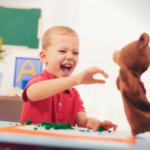
The therapist shows the child what a social skill looks like, explains it in simple terms, and creates opportunities to practice it. Teaching a child to greet a peer, for example, might involve demonstrating the greeting, practicing it together many times, and then gradually introducing real peer interactions.
Role Play
Social scenarios are rehearsed in a structured, low-pressure environment before the child is expected to use them in the real world. Feedback is immediate, specific, and supportive.
Real-World Practice
Once a skill is developing in structured settings, therapists create opportunities to practice it in more natural contexts: during group activities, free play, and community outings.
Children learn social skills in social situations. The more supported opportunities your child has to practice with peers in everyday environments, the more those skills take root and grow.
The Role Parents Play
What happens at home matters. Arranging playdates, using the strategies your child’s therapy team teaches, creating low-pressure opportunities for your child to practice with familiar peers, all of it contributes to their progress.
Your child’s BCBA will work with you on specific strategies you can use outside of sessions. You are not expected to run therapy at home. Parent training is designed to help families reinforce skills during everyday routines and interactions, which can support progress across settings.
Progress Takes Time
Social development is gradual, and the timeline looks different for every child. Some children make noticeable progress within months. Others require longer, more sustained support. Both paths are valid.
Research consistently shows is that systematic, ABA-based social skills instruction produces real gains. Progress may not look like what you imagined. But it is happening, and it compounds over time.
Social Skills at Westside
Helping children with autism connect to the world around them is a central focus of our ABA programs at Westside. Our ABA programs include specific social skills goals for children who need them, taught through direct instruction, peer practice, and naturalistic opportunities designed to help skills move from the therapy room into real life.
If your child is working toward stronger social skills and relationships, our team is here to support that progress. Call us at 815-783-2544 or submit a contact form.
Know a parent who is searching for ways to help their child make friends? This is worth sharing with them.