Toe Walking in Kids: Why Serial Casting Is Often Recommended
| QUICK ANSWER
Most toe walking in young children is idiopathic, meaning it happens without any underlying neurological or orthopedic cause, and a lot of it resolves on its own. When it persists past age 2 or 3, especially with limited ankle flexibility, serial casting for toe walking is one of the most well-supported conservative treatments available, often recommended before bracing or, in more resistant cases, before surgery is considered. |
Why We Treat Persistent Toe Walking as Something to Always Watch Closely
At Westside, we treat persistent toe walking as a pattern that always deserves a closer look, not a phase to wait out. That’s a different message than a lot of parents hear elsewhere. Some general guidance still frames toe walking as something most toddlers simply grow out of, but that framing misses something important: children don’t typically wake up one day and decide to walk flat-footed. They keep walking the way they learned to walk. What looks like “growing out of it” is often a child who compensated to get their feet flat to the ground and now developed other foot deformities such as “flat feet” Part of why this gets missed is that toe walking develops gradually, and in its early stages it’s genuinely hard to catch, even for pediatricians. A child who occasionally rises onto their toes to reach for something isn’t the same as a child whose walking pattern is consistently toe-down. That distinction can be subtle at first, and it’s exactly the stage where intervention is easiest and most effective. Too often, toe walking isn’t flagged as a concern until it’s progressed to the point where a contracture has developed and the child is visibly stuck up on their toes, the stage where serial casting becomes necessary rather than optional.
Our recommendation is straightforward: if you’re noticing a consistent pattern, not just a few isolated steps, it’s worth having your child’s gait and ankle flexibility evaluated directly rather than waiting to see what happens.
Why Serial Casting Is Often the First Recommendation
When toe walking persists and a child shows limited ankle dorsiflexion, meaning the ankle can’t bend upward through its full expected range, serial casting for toe walking has some of the strongest evidence among conservative treatment options. A review of the current literature found stronger evidence supporting gait improvement with serial casting followed by orthoses compared with other nonsurgical approaches 1. One study following children through a course of casting found that 66 percent had an improved gait pattern afterward, based on both clinician and family assessment 2 . That’s a meaningfully high response rate for a treatment that doesn’t involve surgery or medication.
| PULL QUOTE
“A lot of parents come in assuming toe walking is just a phase or were told “they’ll grow out of it” by their pediatrician. Toe walking is a full body postural concern and kids don’t just grow out of that, they grow into it. They either go higher up on their toes or compensate to bring their feet flat to the ground which leads to other postural and foot deformities. When the ankle muscles have tightened, casting is often the most direct way to get that motion back, correct the deformities, and the first step to addressing the postural deficits.” — Abbie Zaremba, PT, Serial Casting Specialist, Westside Children’s Therapy |
What the Casting Process Typically Looks Like
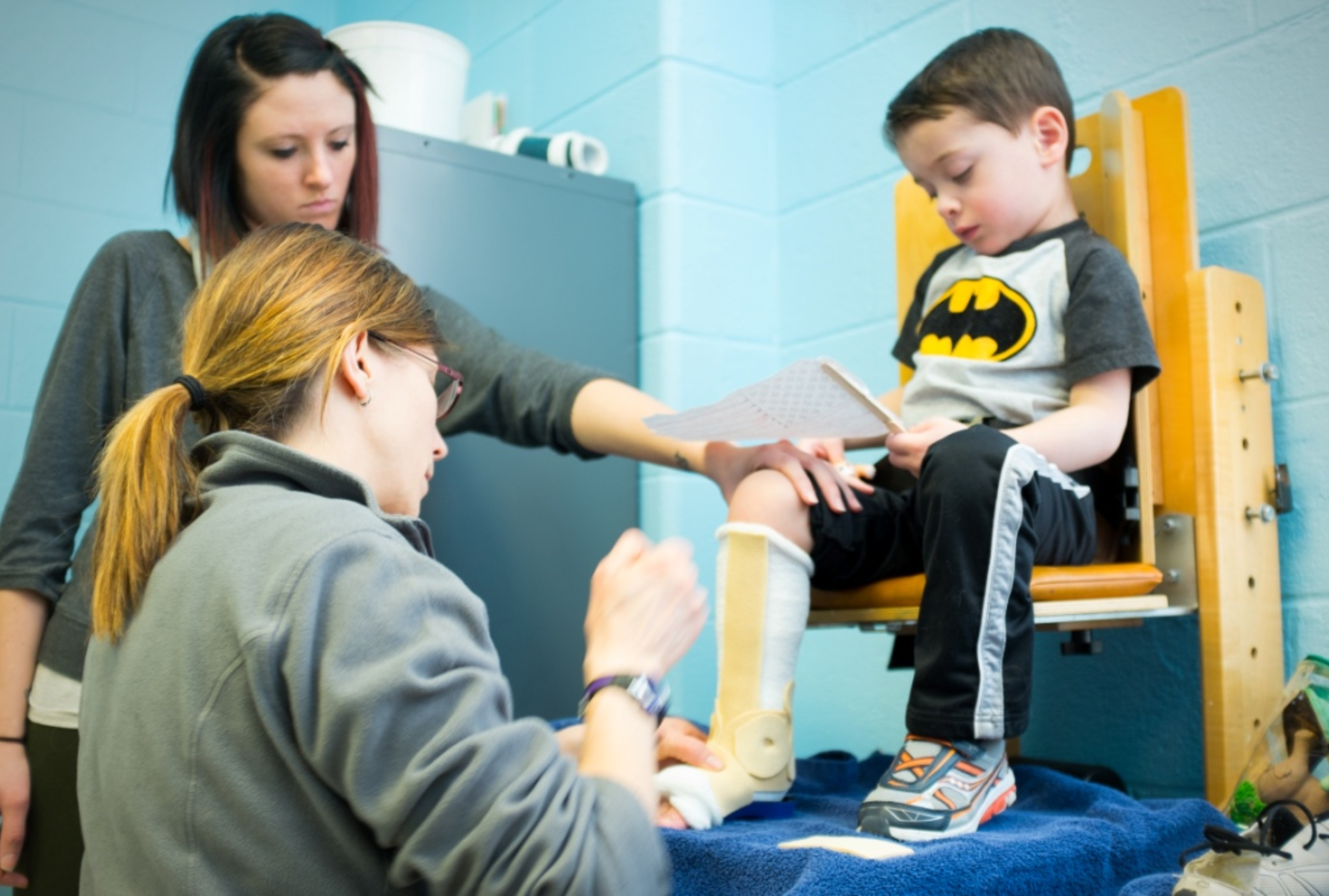
A physical therapist evaluates your child’s ankle range of motion and gait pattern first. If a child has been consistently walking on their toes, their calf muscles may have already tightened enough to limit how far the ankle can move. That’s what makes the toe-walking pattern possible in the first place. Some children may also be dealing with secondary foot and ankle deformities that developed alongside that tightness. An evaluation will pinpoint how much correction is needed and where to focus it.
From there, a series of casts is applied and changed on a set schedule, most commonly weekly or every other week, gradually increasing how far the ankle can move and correcting the deformities. In our own clinical experience, gains of this size in a single week run higher than what we typically see, closer to a few degrees per week on average, with stiffer ankles moving as little as 2 to 3 degrees and more responsive ones moving 7 to 8, so individual results vary. After casting, children continue with bracing or a home stretching program to help maintain the gains.
- Evaluation first: confirming limited ankle flexibility, not just the presence of toe walking
- Casts applied and changed on a set schedule, commonly weekly or every other week
- Progress measured directly through range-of-motion checks at each change
- Bracing or a home program often follows to help maintain the gains achieved
When to Bring This Up With a Physical Therapist
If your child is still toe walking, especially if you’ve noticed their ankle seems stiff, they toe walk consistently rather than occasionally, or there’s a family history of the pattern, it’s worth having their gait and ankle flexibility evaluated directly rather than waiting to see if it resolves on its own. A diagnosis isn’t required to pursue an evaluation, and an evaluation is the only reliable way to know whether your child’s toe walking is the kind likely to resolve unaided or the kind that would benefit from a more targeted approach like serial casting.
Frequently Asked Questions
Does every child who toe walks need serial casting?
No. There are other treatment options if caught early, especially in younger children with normal ankle flexibility. Bracing or orthotics alongside physical therapy may be enough to correct the pattern. Casting is generally recommended when toe walking persists alongside limited ankle range of motion.
At what age should toe walking be evaluated?
As soon as it is noticed, especially if accompanied by stiffness or a consistent inability to walk heel-first, it’s reasonable to have your child’s gait evaluated rather than waiting further.
Is toe walking always idiopathic, or can it signal something else?
It can be associated with conditions like cerebral palsy in some children, which is part of why a proper evaluation, rather than assuming it’s idiopathic, is a useful first step.
How long does a typical course of serial casting for toe walking take?
This varies by child, but many courses run several weeks, with casts changed on a set schedule and range of motion tracked at each change.
Getting a Clear Answer Instead of Waiting to See
Toe walking that persists is worth a real evaluation, not just a wait-and-see approach, especially if your child’s ankle seems stiff.
Learn more about our physical therapy services, or read our more detailed guide on toe walking in children once available. If you have questions about your child’s specific pattern, we’re glad to talk it through with you. Call us at 815-783-2544 or submit a contact form.
Call us at 815-783-2544 or submit a contact form.
Know a family wondering if their toddler’s toe walking is something to look into? Share this with them. It might be exactly what they needed today.
Clinically verified by Abbie Zaremba, PT, DPT, Westside Children’s Therapy