Westside Partners with Mokena Parks & Recreation to Bring Communication Boards to Local Playgrounds
Children Activities, Opportunities
| IN SHORT
Westside Children’s Therapy has partnered with Mokena Parks & Recreation to install AAC communication boards at seven local playgrounds: Whisper Creek Park, Grasmere Park, Fox Ridge Park, Brookside Meadows Park, Tinley Gardens Park, Timbers Point Park, and Hecht Park. These boards use pictures, symbols, and words to give nonverbal and minimally verbal children a way to communicate and connect with peers during play, without needing to rely on spoken language alone. |
What We Did, and Where
Westside Children’s Therapy has partnered with Mokena Parks & Recreation to install AAC communication boards at seven playgrounds across the community. You can find all seven on the Mokena Parks & Recreation park map: Whisper Creek Park, Grasmere Park, Fox Ridge Park, Brookside Meadows Park, Tinley Gardens Park, Timbers Point Park, and Hecht Park. Each board is a permanent, weather-resistant installation at the entrance to the play area, giving every child who visits these parks a shared, visible way to communicate, whether or not they use spoken words.
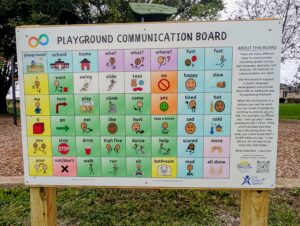
Kids can point to pictures like “go” and “play” to share what they want, how they feel, or when they need a break.
What a Communication Board Actually Is
A communication board is a visual tool that uses pictures, symbols, and words to help a child express needs, wants, and feelings without relying on spoken language. For children who are nonverbal, minimally verbal, or who communicate more easily with visual support, including many children with autism, speech and language delays, or other communication differences, a board like this gives them a real way to participate in play rather than being left on the sidelines of it1. Typically, these boards include vocabulary organized around the specific context they’re installed in, in this case, words and pictures related to playground activities, feelings, and requests a child might want to communicate while playing.
- Whisper Creek Park
- Grasmere Park
- Fox Ridge Park
- Brookside Meadows Park
- Tinley Gardens Park
- Timbers Point Park
- Hecht Park
Why This Matters for Play, Not Just Communication
Unstructured play offers real developmental benefits, but children with communication differences often face barriers to full participation that go beyond simple physical access to the equipment itself2. A child who can’t easily tell a peer what game they want to play, or express that they’re overwhelmed and need a break, is genuinely left out of the social experience of the playground, even if they’re physically standing right in the middle of it. A shared communication board changes that dynamic directly, giving every child at the park a common way to express themselves and connect with the kids around them.
Why We Wanted to Be Part of This
Inclusive play matters to us because it reflects something we see in our work every day: communication differences shouldn’t be the reason a child gets left out of an experience every other kid in the neighborhood gets to have. Partnering with Mokena Parks & Recreation on this installation was a natural extension of that belief, bringing a tool that’s genuinely useful in a therapy setting out into the actual community spaces where kids play, make friends, and build the social skills that carry into every other part of their lives.
Frequently Asked Questions
What is an AAC communication board?
It’s a visual tool using pictures, symbols, and words that helps a child express needs, wants, and feelings without relying on spoken language, giving nonverbal and minimally verbal children a way to communicate.
Which parks have the new communication boards?
Whisper Creek Park, Grasmere Park, Fox Ridge Park, Brookside Meadows Park, Tinley Gardens Park, Timbers Point Park, and Hecht Park.
Who can use the communication boards?
Any child, whether or not they typically use spoken language. The boards are designed to support children who are nonverbal or minimally verbal, but they’re a shared, public tool available to every visitor at the park.
Why did Westside partner with Mokena Parks & Recreation on this?
Inclusive access to play is a natural extension of Westside’s broader commitment to supporting children’s communication and development, bringing tools we use in therapy out into everyday community spaces.
Will more communication boards be installed at other parks in the future?
This installation reflects an ongoing commitment to inclusive play in the community, and we’re glad to share updates if this partnership expands to additional locations.
A Shared Way to Play, for Every Child
These communication boards give every child at these seven Mokena parks a real way to connect with the kids around them, regardless of how they communicate.
If your child could benefit from support around communication, our speech-language and ABA therapy teams are glad to help. Call us at 815-783-2544 or submit a contact form.
Know a family in Mokena with a child who could benefit from these new communication boards? Share this with them. It might be exactly the resource they’ve been looking for.
Where to Go Next